Saturday, January 07, 2006
Theories is too kind a word
I’m reading Theories of Political Economy for class. The authors outline three different definitions of political economy:
a) the economy is the market, politics is government, and ne’er the twain shall meet.
b) Everything is economics. Politics, family, your houseplants, it’s all governed by rational choice. You pursue ends based on the most efficient means available.
c) The economy is the social processes by which we as a society reproduce ourselves, or 'provisioning'.
 I'm a rational economic actor pursuing calculated ends! Want to buy some chips?
I’m leaving out their debates about what ‘the public’ is, the difference between the government and the state, and how to determine what economic rationality is. Why? Because it’s bourgeois economics, and that’s ideology, not science.
I was reading this stuff on the metro yesterday; we had a power outage and the train sat on the tracks. Being a dutiful student, I saw a chance to catch up on my reading. Instead I nearly fell asleep. This is dry stuff.
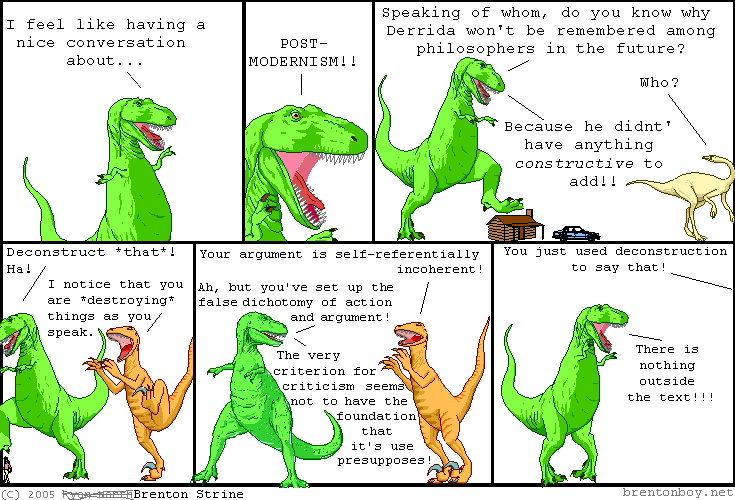
I’m not anti-intellectual (obviously, since I aspire to make that peculiar form of neurotic alienation my life’s calling.) If something’s hard to ‘get’, it doesn’t mean it’s useless. Often the most important ideas take a lot of work: abstraction is not something we’re used to absorbing. In capitalism, ideas circulate like capital does: at an ever-increasing speed, spiraling across the globe. Intellectual fads – blink this, post- that – are part of instant gratification. The more commodities – mental or material – that are created, the more money is made, and the system reproduces itself. Complex ideas can be the mental equivalent of the slow-food movement: they take time to prepare, but they’re less commodified, and more satisfying, because they describe the system at a greater level of complexity.
 There's a difference between complicated and complex - by Brenton Sprine
Real complexity only comes from one place: the social relations of reality itself. But economists don't create a model from everyday life. They pull their models from their own heads, slicing and freezing reality. It's not complex - it’s mind-numbingly simplistic, and paradoxically enough, that’s what makes it difficult. Listen to this:
 There's no more 'forceful expression of efficiency' than dirty, diseased water
Real things covered with dry, abstract language, riddled with assumptions the authors don't see - this is Marx's 'tricks of ideology' if I ever saw it:
1) ‘Efficiency’ is a catchphrase for speed-up, the dominance of machines over human labour. Computers make tasks efficient, but then ‘excess’ workers are fired and there’s just more to do for everyone left.
2) ‘Acquiring things we want or need’ - human existence is acquiring the stuff of life. This is a tautology – Marx’s favourite word, and mine too, the more I read this stuff – something so bloody simple & obvious that it proves nothing. How are those needs created? Why do we satisfy them the way we do? The economists don't know - or care.
3) Finally, ‘market institutions’ that “seem to embody most forcefully the achievement of efficiency”? Does this include ‘natural’ unemployment rates? The biggest gap between rich or poor ever? How about the billion people without clean water? Markets are so damned efficient they need neoliberalism, imperialism and war to make sure they work.
These are not neutral terms. They’re capitalist. They express a bourgeois point of view: they treat the institutions of class exploitation as natural and normal, when in fact they express and conceal relations of dominance and power. Economics is about justifying institutions like the market that create inequality. It generalizes the myth of ‘rational individuals’ that, in fact, refer to rational capitalists: people with power and money to coerce others into working for them. Which explains why something so dry and dull could become a field of inquiry: it’s the fantasies capitalists tell about themselves, their particular class interests writ large.
 Stanford U. Republicans, or Dungeons & Dragons club? There's a reason you can't tell the difference
In the same way that it’s refreshing to hear Bush defend secret wire-taps by bleating, “Just admitting they exist helps the terrorists!”, it’s refreshing to hear capitalism defended so bluntly. You really get a sense of how the system works, minus all the liberal bullshit about values and laws:
 Honeeeey... if you don't go to work you'll run out of these...
Don’t ask where that ‘productive capital’ comes from; don’t wonder why, when the workers ‘deny access’ to the workplace themselves and go on strike, the capitalists are suddenly keen to restore “the compulsion to work”. In other words, don’t actually investigate the social reality of billions of people the world over. If this is the ideological bulwark of capitalism – if this is the best the economists have to offer – then, as someone said, ‘the soup is very thin’. Which makes me happy, in a strange way.
I recognize that I need to know this stuff, if I’m ever going to take on capitalists in the real world. Believe me, I want to: to learn that their smug self-confidence rests on such flimsy foundations makes me even angrier at the system. If they’re going to destroy the planet, you’d think they’d at least have better grounds to do it than “What’s mine is mine, and what’s yours is mine.” But at the same time, reading it is frustrating. It pisses me off that it’s presented neutrally, as if it’s just a choice we make, like listening to Jessica Simpson rather than Britney Spears.
 Capitalism? War? The bloated bodies of 100,000 dead Iraqis? It's just all so wonderful I can't choose!
Posing it as a choice between different intellectual systems is the most bourgeois trick of all. It’s not a choice: capitalism is a compulsion for everyone, not least the capitalists themselves. We enter into these social relations because we have to, in order to survive: the system takes on its own logic. This leaves us with two choices: support it, or destroy it. I like to see that choice posed clearly. I don’t like to see the myriad of distractions in the way, the sticky translucent film obscuring reality. The fact that economics is a ‘science’ of those distractions speaks volumes about the hollow myths capitalism whispers itself to sleep with every night.
a) the economy is the market, politics is government, and ne’er the twain shall meet.
b) Everything is economics. Politics, family, your houseplants, it’s all governed by rational choice. You pursue ends based on the most efficient means available.
c) The economy is the social processes by which we as a society reproduce ourselves, or 'provisioning'.
 I'm a rational economic actor pursuing calculated ends! Want to buy some chips?
I’m leaving out their debates about what ‘the public’ is, the difference between the government and the state, and how to determine what economic rationality is. Why? Because it’s bourgeois economics, and that’s ideology, not science.
I was reading this stuff on the metro yesterday; we had a power outage and the train sat on the tracks. Being a dutiful student, I saw a chance to catch up on my reading. Instead I nearly fell asleep. This is dry stuff.
I’m not anti-intellectual (obviously, since I aspire to make that peculiar form of neurotic alienation my life’s calling.) If something’s hard to ‘get’, it doesn’t mean it’s useless. Often the most important ideas take a lot of work: abstraction is not something we’re used to absorbing. In capitalism, ideas circulate like capital does: at an ever-increasing speed, spiraling across the globe. Intellectual fads – blink this, post- that – are part of instant gratification. The more commodities – mental or material – that are created, the more money is made, and the system reproduces itself. Complex ideas can be the mental equivalent of the slow-food movement: they take time to prepare, but they’re less commodified, and more satisfying, because they describe the system at a greater level of complexity.
 There's a difference between complicated and complex - by Brenton Sprine
Real complexity only comes from one place: the social relations of reality itself. But economists don't create a model from everyday life. They pull their models from their own heads, slicing and freezing reality. It's not complex - it’s mind-numbingly simplistic, and paradoxically enough, that’s what makes it difficult. Listen to this:
First, the term economics is sometimes used to refer to a way of doing things, as in the word “economically”. If we use the term in this way, it carries the connotations of efficiency, minimum effort, and close adaptation of means to ends. Second, the term economic sometimes refers to a kind of activity, usually aimed (as in production) at acquiring things we want or need. The term “provisioning” expresses this sense of what is economic. A third usage of economic ties it to market institutions. These institutions seem to embody most forcefully the achievement of efficiency in the activities aimed at acquiring for us the things we need.
 There's no more 'forceful expression of efficiency' than dirty, diseased water
Real things covered with dry, abstract language, riddled with assumptions the authors don't see - this is Marx's 'tricks of ideology' if I ever saw it:
1) ‘Efficiency’ is a catchphrase for speed-up, the dominance of machines over human labour. Computers make tasks efficient, but then ‘excess’ workers are fired and there’s just more to do for everyone left.
2) ‘Acquiring things we want or need’ - human existence is acquiring the stuff of life. This is a tautology – Marx’s favourite word, and mine too, the more I read this stuff – something so bloody simple & obvious that it proves nothing. How are those needs created? Why do we satisfy them the way we do? The economists don't know - or care.
3) Finally, ‘market institutions’ that “seem to embody most forcefully the achievement of efficiency”? Does this include ‘natural’ unemployment rates? The biggest gap between rich or poor ever? How about the billion people without clean water? Markets are so damned efficient they need neoliberalism, imperialism and war to make sure they work.
These are not neutral terms. They’re capitalist. They express a bourgeois point of view: they treat the institutions of class exploitation as natural and normal, when in fact they express and conceal relations of dominance and power. Economics is about justifying institutions like the market that create inequality. It generalizes the myth of ‘rational individuals’ that, in fact, refer to rational capitalists: people with power and money to coerce others into working for them. Which explains why something so dry and dull could become a field of inquiry: it’s the fantasies capitalists tell about themselves, their particular class interests writ large.
 Stanford U. Republicans, or Dungeons & Dragons club? There's a reason you can't tell the difference
 In the same way that it’s refreshing to hear Bush defend secret wire-taps by bleating, “Just admitting they exist helps the terrorists!”, it’s refreshing to hear capitalism defended so bluntly. You really get a sense of how the system works, minus all the liberal bullshit about values and laws:
under capitalism, everyone’s labor is self-owned. It cannot legally be coerced or pressed into service. One may feel the compulsion to work, but this comes from the need to have an income to purchase the essential consumption goods. Thus, under capitalism, one sells his or her labor in return for a wage. By the same token, workers do not have entitlement to a job… Productive capital is privately owned and owners are not forced to make this capital available for the employment of the labor of others. Denial of access is an important property right of the capitalists.There – you can’t put it more simply. Workers are greedy bastards who just want Cheetos and iPods, and now these fat slobs are banging on the factory door to get inside. The capitalists are doing us a favour by letting us work. Otherwise we’d just sit at home, drink beer and watch tv.
 Honeeeey... if you don't go to work you'll run out of these...
Don’t ask where that ‘productive capital’ comes from; don’t wonder why, when the workers ‘deny access’ to the workplace themselves and go on strike, the capitalists are suddenly keen to restore “the compulsion to work”. In other words, don’t actually investigate the social reality of billions of people the world over. If this is the ideological bulwark of capitalism – if this is the best the economists have to offer – then, as someone said, ‘the soup is very thin’. Which makes me happy, in a strange way.
I recognize that I need to know this stuff, if I’m ever going to take on capitalists in the real world. Believe me, I want to: to learn that their smug self-confidence rests on such flimsy foundations makes me even angrier at the system. If they’re going to destroy the planet, you’d think they’d at least have better grounds to do it than “What’s mine is mine, and what’s yours is mine.” But at the same time, reading it is frustrating. It pisses me off that it’s presented neutrally, as if it’s just a choice we make, like listening to Jessica Simpson rather than Britney Spears.
 Capitalism? War? The bloated bodies of 100,000 dead Iraqis? It's just all so wonderful I can't choose!
Posing it as a choice between different intellectual systems is the most bourgeois trick of all. It’s not a choice: capitalism is a compulsion for everyone, not least the capitalists themselves. We enter into these social relations because we have to, in order to survive: the system takes on its own logic. This leaves us with two choices: support it, or destroy it. I like to see that choice posed clearly. I don’t like to see the myriad of distractions in the way, the sticky translucent film obscuring reality. The fact that economics is a ‘science’ of those distractions speaks volumes about the hollow myths capitalism whispers itself to sleep with every night.