
Monday, February 23, 2009
The End Is Nigh, Part Two
(Read Part One here.)
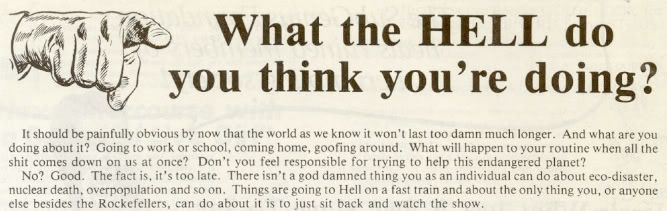
Examine the above ad for a moment. It’s quite clever, ironic and nihilistic. But this isn’t post-millenial angst for the jaded, post-everything generation: it’s from 1980.
30 year old Doomsterism sounds exactly the same as Doomsterism today. If you keep harping on about catastrophe, your predictions may one day be borne out (in a distorted, ahistoric way.) But as Keynes said, in the long run everybody dies. This gets you no further to understanding reality, let alone changing it.
Peak Oil
Reality of late has not been kind to the Doomsters. Remember last year’s oil price spike? Peak oil advocates predicted further rises. The spectacular drop in prices to $40 a barrel, less than half of last year's spike, has done nothing to dent their enthusiasm. Rather, the dip is simply due to volatility, and it won't last. Oil will hit $300 a barrel, and then: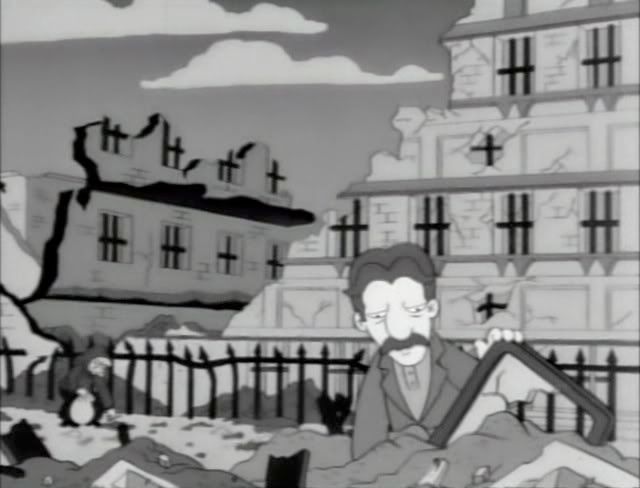
Something to look forward to?
Peak oil predicts rising oil prices, and then the exact opposite happens. I'd kindly suggest that blaming everything on "volatility" is intellectually bankrupt. As a friend pointed out to me, even a stuck, broken clock is right twice a day. Since the Doomsters can't even explain the symptoms of what they're seeing, they certainly can't understand the cause.
After all, the Doomsters have been predicting crises for decades. Yet when the biggest crisis in the post-WW2 era hit, it had nothing to do with finite resource supplies, and everything to do with toxic debt and an overaccumulation of surplus capital. The social conditions of production caused the current crisis: the contradiction between the use-value of what humanity produces, and the profit that capitalists expected to make on that production. Surplus profits fuelled massive speculation, as capital that couldn't be invested profitably today sought future profits in esoteric futures.

Hand it over
Capitalist radicals
Where did the Doomsters get the idea that capitalism is based on physical, technical conditions of production? For all its counter-cultural cachet, this comes straight from bourgeois economics. According to every neoclassical economist, capitalism is a straight adding-up of land, labour and capital. Workers, landlords and capitalists bring what they have to the market, and receive the value of that contribution in wages, rent and revenue. This led to any number of technical 'fixes' for capitalism by its apologists: change the amount of inputs, free the market and let it regulate production, or regulate the market to adjust for disequilibrium. But for god's sakes leave the system as it is.
This is pure fantasy, peddled by the powerful. Marx saw that the system was not neutral: it grinds on because people have no choice but to participate. They have nothing to sell but their labour power. Capitalists regulate production - but they do so individually, trying to determine social need in a chaotic war of all-against-all. Wealth gets created socially, and appropriated individually. Or more prosaically, stolen by the capitalist class from the workers.
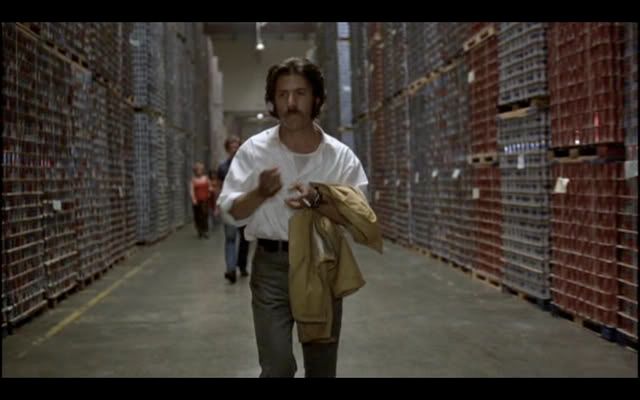
"Accompanied by Mr. Moneybags and by the possessor of labour-power, we therefore take leave for a time of this noisy sphere, where everything takes place on the surface and in view of all men, and follow them both into the hidden abode of production, on whose threshold there stares us in the face 'No admittance except on business.'" Capital Vol. 1, Ch. 6 - Straight Time
The system is governed by power, a set of social relations of exploitation. Physical, finite limits matter to the extent that capitalists will grab whatever they can to compete. But the causes and effects of crisis are purely social. Even when physical limits begin to impose themselves on the capitalist system - like global warming - the winners and losers are determined by who has command over capital.
It's your fault
Recently, a Doomster on a Guardian.co.uk comment box enthused that the recession was a chance for us to correct our ways: we'd been over-using our resources, but Mother Earth was giving us a second chance. Here's a milder version from Nikiforuk et al:
Why weren't you saving your capital? - Soy Cuba
In his denunciation of lifestyle anarchism, Murray Bookchin gives a marvellous account of those who substitute how they live for political struggle:
Apparently - Sexjack
Of course, the fantasists of doom have no understanding of where hunger, poverty or environmental destruction come from, other than vague notions of ‘industrialism’ and technology (though not, apparently, when it comes to the machines making their canning jars, cycling parts or solar panels.) They want to do away with the washing machines – and thus they want to do away with the working women and children who use them. The catastrophe literature seethes with barely-veiled contempt for the people who don’t ‘get it’ i.e. everybody else. Carlsson quotes an ecologist who argues

Too many Midnight Madness sales - Deadset
To be fair, there’s a kernel of truth in this: consumerism is a compensation for the alienating conditions of work we’re forced to do. But it doesn’t erase the contradictions. Chief among those is that consumption is not a bad choice by stupid people - it’s a strategy for capitalist expansion. As Ernest Mandel argues, capitalism must “create a genuine world market for all its commodities instead of only for the luxury goods which were traded internationally in the pre-capitalist age. The cheap mass production made possible by capitalist large industry was the most important weapon in this process” (310).
Note the past-tense: mass production and mass consumption have already happened. They’re not a choice. Why? Because “Capital by its very nature tolerates no geographical limits to its expansion. Its historical ascent led to the levelling of regional boundaries and the formation of large national markets, which laid the foundation for the creation of the modern nation state.” (310)
The potential unleashed by mass production is enormous
Racist localism
National markets? Nation-states? What do people who just want to grow their own vegetables and chortle as the urban masses revert to cannibalism have to say about that? Nothing: back to the catch-all answer, catastrophe. It will shear – or, more accurately, cull – the sheep. The move to ‘small and sustainable’, argued for by every Doomster and localist, never says what to do about the large population which would assuredly become unsustainable, as soon as those basic industries shut down. We just need fewer people. Eric Schumacher, founder of Buddhist economics and author of the much-lauded, ‘pacifist’ Small Is Beautiful, denounces large-scale production and has this to say about the people drawn into it:
Why can't you understand how irresponsible you are?
If you believe catastrophe is inevitable from industrialism, technology and size, then the answer is to keep people from pursuing those things. Local communities for local people. Self-described left-winger Lyle Estill has this to say of people who come from far away: “People who live in a community have a vested interest in strengthening that community. Those are the ones who accept and receive local currency. People who live far away take their expertise, and their spending power, home with them each night.” (173) Why not make it simpler and just say, “Immigrants take our jobs.” Because that’s the racist, anti-immigrant argument Doomsterism boils down to. If you think that people can choose their own role in capitalist economy, then they are at fault for choosing to move – for being too greedy and wanting to consume more. Workers don't have a right to travel where capital does: they should stay put and starve.
The Doomsters live in a comfortable bubble inside the imperialist world. They don’t see the barbarism that envelopes the poor everywhere and can posit their fears of collapse as something unique. They substitute industrialism, technology or people’s stupidity for the inherent drive of capitalism to expand. If you can’t see the cause, then you can’t see the solution – ergo, there is none, and catastrophe is the inevitable result. None of those things can be changed by collective action: on the contrary, the mass of people are to blame. All we can do is wait for the collapse. The misanthropy close to the surface of every Doomster’s heart quickly turns to racism.
Easy if you're a disenchanted liberal - Un Conte de Noel
Unlike me, Ernest Mandel is able to keep a cool head around these people:
La Commune
None of which is to deny that workers’ struggle is at a low ebb. But as the economic crisis deepens, and people begin to resist the imposition of austerity – as they’ve done in Iceland, Greece and France, to name a few examples – they will look for political leadership. British police are predicting a summer of rage from laid-off workers. Localists and Doomsters have nothing to say to them: their abstract, dystopian imaginings live outside the realities of most people. Fearing the sky is falling doesn’t absolve you from finding a way to prevent it, right now.

Examine the above ad for a moment. It’s quite clever, ironic and nihilistic. But this isn’t post-millenial angst for the jaded, post-everything generation: it’s from 1980.
30 year old Doomsterism sounds exactly the same as Doomsterism today. If you keep harping on about catastrophe, your predictions may one day be borne out (in a distorted, ahistoric way.) But as Keynes said, in the long run everybody dies. This gets you no further to understanding reality, let alone changing it.
Peak Oil
Reality of late has not been kind to the Doomsters. Remember last year’s oil price spike? Peak oil advocates predicted further rises. The spectacular drop in prices to $40 a barrel, less than half of last year's spike, has done nothing to dent their enthusiasm. Rather, the dip is simply due to volatility, and it won't last. Oil will hit $300 a barrel, and then:
"It will be a slow deterioration in our quality of life, in the reliability of transportation, in the availability of certain foods as well as price spikes for food," [author Andrew] Nikiforuk said.
"It will cause pandemonium in both the public and private spheres."

Something to look forward to?
Peak oil predicts rising oil prices, and then the exact opposite happens. I'd kindly suggest that blaming everything on "volatility" is intellectually bankrupt. As a friend pointed out to me, even a stuck, broken clock is right twice a day. Since the Doomsters can't even explain the symptoms of what they're seeing, they certainly can't understand the cause.
After all, the Doomsters have been predicting crises for decades. Yet when the biggest crisis in the post-WW2 era hit, it had nothing to do with finite resource supplies, and everything to do with toxic debt and an overaccumulation of surplus capital. The social conditions of production caused the current crisis: the contradiction between the use-value of what humanity produces, and the profit that capitalists expected to make on that production. Surplus profits fuelled massive speculation, as capital that couldn't be invested profitably today sought future profits in esoteric futures.

Hand it over
Capitalist radicals
Where did the Doomsters get the idea that capitalism is based on physical, technical conditions of production? For all its counter-cultural cachet, this comes straight from bourgeois economics. According to every neoclassical economist, capitalism is a straight adding-up of land, labour and capital. Workers, landlords and capitalists bring what they have to the market, and receive the value of that contribution in wages, rent and revenue. This led to any number of technical 'fixes' for capitalism by its apologists: change the amount of inputs, free the market and let it regulate production, or regulate the market to adjust for disequilibrium. But for god's sakes leave the system as it is.
This is pure fantasy, peddled by the powerful. Marx saw that the system was not neutral: it grinds on because people have no choice but to participate. They have nothing to sell but their labour power. Capitalists regulate production - but they do so individually, trying to determine social need in a chaotic war of all-against-all. Wealth gets created socially, and appropriated individually. Or more prosaically, stolen by the capitalist class from the workers.

"Accompanied by Mr. Moneybags and by the possessor of labour-power, we therefore take leave for a time of this noisy sphere, where everything takes place on the surface and in view of all men, and follow them both into the hidden abode of production, on whose threshold there stares us in the face 'No admittance except on business.'" Capital Vol. 1, Ch. 6 - Straight Time
The system is governed by power, a set of social relations of exploitation. Physical, finite limits matter to the extent that capitalists will grab whatever they can to compete. But the causes and effects of crisis are purely social. Even when physical limits begin to impose themselves on the capitalist system - like global warming - the winners and losers are determined by who has command over capital.
It's your fault
Recently, a Doomster on a Guardian.co.uk comment box enthused that the recession was a chance for us to correct our ways: we'd been over-using our resources, but Mother Earth was giving us a second chance. Here's a milder version from Nikiforuk et al:
"Save your capital. Reduce your consumption. A lot. Make yourself accessible to mass transit," Hughes said. "And forget about buying things at Wal-Mart that were shipped here from halfway around the world."I'll forget for a moment the ludicrous idea that any of us have capital to save. The important point here is his moralism. Once the crisis hits - and he's talking about the oil crisis, not the recession - the solution is changing individual behaviour. This is the essence of capitalist ideology: we're sovereign consumers. Those who don't shift their market preferences are "fat and lazy". Blame the individual.
"You prepare by walking more, operating one vehicle. You prepare by buying more food locally and talking to your friends about getting engaged in the political process," said Nikiforuk. "Oil has made us fat and lazy.

Why weren't you saving your capital? - Soy Cuba
In his denunciation of lifestyle anarchism, Murray Bookchin gives a marvellous account of those who substitute how they live for political struggle:
“Today, dabbling in primitivism is precisely the privilege of affluent urbanites who can afford to toy with fantasies denied not only to the hungry and poor... but to the overworked employed. Modern working women with children could hardly do without washing machines to relieve them, however minimally, from their daily domestic labors". (49)

Apparently - Sexjack
Of course, the fantasists of doom have no understanding of where hunger, poverty or environmental destruction come from, other than vague notions of ‘industrialism’ and technology (though not, apparently, when it comes to the machines making their canning jars, cycling parts or solar panels.) They want to do away with the washing machines – and thus they want to do away with the working women and children who use them. The catastrophe literature seethes with barely-veiled contempt for the people who don’t ‘get it’ i.e. everybody else. Carlsson quotes an ecologist who argues
“’our whole society is like a teenager who wants to have it all, have it now, without consequences.’ A culture that simultaneously glorifies and fears adolescence while promoting a shallow hedonism is perfectly suited to the mass consumerism that underpins modern capitalism.” (72)We’re teenagers who don’t think about the consequences. We turned into sheeple because of consumerism: “People were encouraged to express their individuality by owning distinctive products, from cars and clothes to furniture and books, a process that helped turn ‘the masses’ into self-expressing individuals committed to their uniqueness rather than their shared realities.” (173) Somehow, as soon as we got bright, pretty baubles to look at, we forgot about struggle.

Too many Midnight Madness sales - Deadset
To be fair, there’s a kernel of truth in this: consumerism is a compensation for the alienating conditions of work we’re forced to do. But it doesn’t erase the contradictions. Chief among those is that consumption is not a bad choice by stupid people - it’s a strategy for capitalist expansion. As Ernest Mandel argues, capitalism must “create a genuine world market for all its commodities instead of only for the luxury goods which were traded internationally in the pre-capitalist age. The cheap mass production made possible by capitalist large industry was the most important weapon in this process” (310).
Note the past-tense: mass production and mass consumption have already happened. They’re not a choice. Why? Because “Capital by its very nature tolerates no geographical limits to its expansion. Its historical ascent led to the levelling of regional boundaries and the formation of large national markets, which laid the foundation for the creation of the modern nation state.” (310)

The potential unleashed by mass production is enormous
Racist localism
National markets? Nation-states? What do people who just want to grow their own vegetables and chortle as the urban masses revert to cannibalism have to say about that? Nothing: back to the catch-all answer, catastrophe. It will shear – or, more accurately, cull – the sheep. The move to ‘small and sustainable’, argued for by every Doomster and localist, never says what to do about the large population which would assuredly become unsustainable, as soon as those basic industries shut down. We just need fewer people. Eric Schumacher, founder of Buddhist economics and author of the much-lauded, ‘pacifist’ Small Is Beautiful, denounces large-scale production and has this to say about the people drawn into it:
the movement of populations, except in periods of disaster, was confined to persons who had a very special reason to move...
But now everything and everybody has become mobile. All structures are threatened, and all structures are vulnerable to an extent that they have never been before.” (51)

Why can't you understand how irresponsible you are?
If you believe catastrophe is inevitable from industrialism, technology and size, then the answer is to keep people from pursuing those things. Local communities for local people. Self-described left-winger Lyle Estill has this to say of people who come from far away: “People who live in a community have a vested interest in strengthening that community. Those are the ones who accept and receive local currency. People who live far away take their expertise, and their spending power, home with them each night.” (173) Why not make it simpler and just say, “Immigrants take our jobs.” Because that’s the racist, anti-immigrant argument Doomsterism boils down to. If you think that people can choose their own role in capitalist economy, then they are at fault for choosing to move – for being too greedy and wanting to consume more. Workers don't have a right to travel where capital does: they should stay put and starve.
The Doomsters live in a comfortable bubble inside the imperialist world. They don’t see the barbarism that envelopes the poor everywhere and can posit their fears of collapse as something unique. They substitute industrialism, technology or people’s stupidity for the inherent drive of capitalism to expand. If you can’t see the cause, then you can’t see the solution – ergo, there is none, and catastrophe is the inevitable result. None of those things can be changed by collective action: on the contrary, the mass of people are to blame. All we can do is wait for the collapse. The misanthropy close to the surface of every Doomster’s heart quickly turns to racism.

Easy if you're a disenchanted liberal - Un Conte de Noel
Unlike me, Ernest Mandel is able to keep a cool head around these people:
“Philosophers who fall prey to the fetishism of technology and overestimate the ability of late capitalism to achieve the integration of the masses, typically forget the fundamental contradiction between use-value and exchange-value by which capitalism is riven, when they seek to prove the hopelessness of popular resistance...” (507)This means that, no matter how much use consumers get from mass production, they are still driven to sell their labour power for a wage in order to survive. Due to that contradiction, capitalism is not stable: it must drive down wages and living conditions to maintain profits. Technology, industrialism, and people who watch Survivor are a symptom, not a cause. More importantly, the unthinking consumers who the Doomsters condemn, and the localists chide, contain the seeds of the solution. The workers’ grudging acceptance of capitalism co-exists with a deep hatred of its exploitation and misery. Collective action against capitalism can bring the irrational drives of expansion under rationally planned, democratic control.

La Commune
None of which is to deny that workers’ struggle is at a low ebb. But as the economic crisis deepens, and people begin to resist the imposition of austerity – as they’ve done in Iceland, Greece and France, to name a few examples – they will look for political leadership. British police are predicting a summer of rage from laid-off workers. Localists and Doomsters have nothing to say to them: their abstract, dystopian imaginings live outside the realities of most people. Fearing the sky is falling doesn’t absolve you from finding a way to prevent it, right now.
Labels: class consciousness, credit crisis, Doomsters, localism, Peak Oil


