
Monday, April 27, 2009
Party like it's a swine-flu pandemic!
The pandemic you were waiting for is on its way. Swine-flu began at a pork-processing plant in Mexico and has spread around the world. It's now a Level 4 threat: not yet a pandemic, but the World Health Organization says "there is now sustained transmission of the infection from human to human. It is two phases short of a pandemic... to raise the threat level further would require evidence that the virus was strong enough to infect whole communities across the globe."

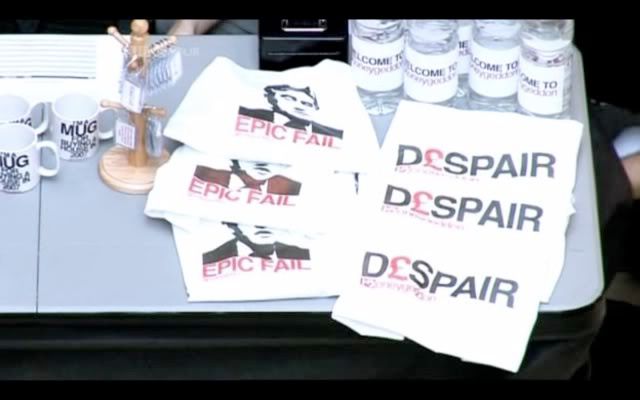
And if not, why not? - Newswipe
I've written how our culture is suffused with catastrophe. People are faced with multiplying economic, social and ecological crises. They're unable to understand them as different facets of one larger crisis of the capitalist mode of production. Swine flu fills an existential void: we know it's a few minutes to midnight, and here's proof. Never mind that good old regular influenza kills a million people a year, and there are dozens of infectious diseases ravaging poor countries at any one moment. Swine flu is affecting us in the wealthy countries, so we have to care.
I'm waiting for the racist backlash to begin, when Mexicans start getting blamed for this crisis. In fact the pork-processing plant is owned by an American multinational with a shoddy environmental record:
Survivors. I started watching the 1970s version of this and am now glad I stopped.
$12.6 million in exchange for decades of pollution - what's that, Smithfield's breakfast conference budget for a few fiscal quarters? The industrial meat industry is notorious for overcrowding, effluent run-off and overuse of antibiotics. Mike Davis brilliantly dissects their logic:

A lot of things are - Japan: a story of love & hate
But investment wasn't made in public healthcare or preventative medicine - which might affect the business practices of the agribusinesses so precious to the economy. Nor were rich countries willing to aid poorer nations' healthcare systems, particularly not after spending the last 30 years privatizing them. The villagers at the epicentre of the swine-flu outbreak knew something was wrong a month ago, but no one listened to them:
This may not be 'the big one', but one thing's for sure: it's not a natural epidemic. It's another capitalist crisis, to be lined up alongside global warming and foreclosures. I don't mean there are men in tophats in a back room, rubbing their hands and plotting the downfall of the world's poor. I mean that capitalism, as a system, is completely unable to take account of long-term consequences. A pandemic would shut borders and further cut trade, deepening the recession, making things worse for everyone. But the rule for all capitalists is profit or die, which means agribusiness cuts corners, governments cut costs and Big Pharma funds medicine, not prevention. Crisis is inevitable and people - particularly poor people - die.
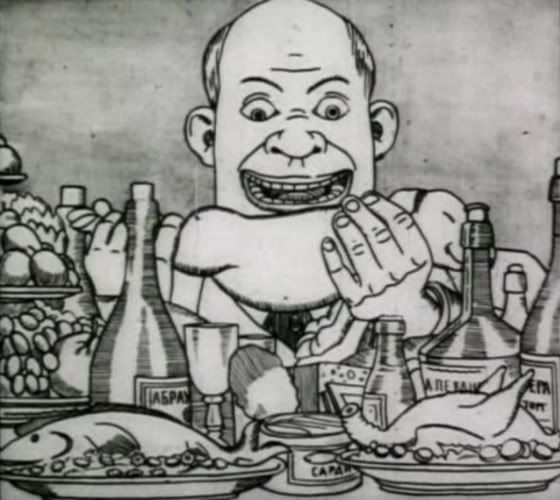
Mmm, that's a tasty metaphor for capitalist greed! - Soviet Toys
Finally, even a pandemic has its plusses and minuses. Minus: I'm smack in the middle of the swine flu's target age range:

"Are we safe yet?"
"Dunno, let's have another to be sure." - Looks & Smiles

And if not, why not? - Newswipe
I've written how our culture is suffused with catastrophe. People are faced with multiplying economic, social and ecological crises. They're unable to understand them as different facets of one larger crisis of the capitalist mode of production. Swine flu fills an existential void: we know it's a few minutes to midnight, and here's proof. Never mind that good old regular influenza kills a million people a year, and there are dozens of infectious diseases ravaging poor countries at any one moment. Swine flu is affecting us in the wealthy countries, so we have to care.

I'm waiting for the racist backlash to begin, when Mexicans start getting blamed for this crisis. In fact the pork-processing plant is owned by an American multinational with a shoddy environmental record:
Smithfield, which is led by pork baron Joseph W Luter III, has previously been fined for environmental damage in the US. In October 2000 the supreme court upheld a $12.6m (£8.6m) fine levied by the US environmental protection agency which found that the company had violated its pollution permits in the Pagan River in Virginia which runs towards Chesapeake Bay. The company faced accusations that faecal and other bodily waste from slaughtered pigs had been dumped directly into the river since the 1970s.
Survivors. I started watching the 1970s version of this and am now glad I stopped.
$12.6 million in exchange for decades of pollution - what's that, Smithfield's breakfast conference budget for a few fiscal quarters? The industrial meat industry is notorious for overcrowding, effluent run-off and overuse of antibiotics. Mike Davis brilliantly dissects their logic:
Animal husbandry in recent decades has been transformed into something that more closely resembles the petrochemical industry than the happy family farm depicted in school readers.The problem is not farm size per se: it's that economies of scale are only economical when environmental costs aren't considered. NAFTA devastated Mexico's rural economy, so it makes sense Mexicans would be happy to welcome an American agribusiness and not look too closely at what, after all, are industry-wide standards. Davis goes on to show this outbreak has been predicted for some time:
In 1965, for instance, there were 53m US hogs on more than 1m farms; today, 65m hogs are concentrated in 65,000 facilities. This has been a transition from old-fashioned pig pens to vast excremental hells, containing tens of thousands of animals with weakened immune systems suffocating in heat and manure while exchanging pathogens at blinding velocity with their fellow inmates.
Since its identification during the Great Depression, H1N1 swine flu had only drifted slightly from its original genome. Then in 1998 a highly pathogenic strain began to decimate sows on a farm in North Carolina and new, more virulent versions began to appear almost yearly.

A lot of things are - Japan: a story of love & hate
But investment wasn't made in public healthcare or preventative medicine - which might affect the business practices of the agribusinesses so precious to the economy. Nor were rich countries willing to aid poorer nations' healthcare systems, particularly not after spending the last 30 years privatizing them. The villagers at the epicentre of the swine-flu outbreak knew something was wrong a month ago, but no one listened to them:
Residents of the town of Perote said at the time that they had a new, aggressive bug — even taking to the streets to demonstrate against the pig farm they blamed for their illness — but were told they were suffering from a typical flu. It was only after U.S. labs confirmed a swine flu outbreak that Mexican officials sent the boy's sample in for swine flu testing.We face a patchwork of regulations and vaccine availability, based on the ability and willingness of governments to pay. And how much is a government going to spend to prevent something that might not happen?
This may not be 'the big one', but one thing's for sure: it's not a natural epidemic. It's another capitalist crisis, to be lined up alongside global warming and foreclosures. I don't mean there are men in tophats in a back room, rubbing their hands and plotting the downfall of the world's poor. I mean that capitalism, as a system, is completely unable to take account of long-term consequences. A pandemic would shut borders and further cut trade, deepening the recession, making things worse for everyone. But the rule for all capitalists is profit or die, which means agribusiness cuts corners, governments cut costs and Big Pharma funds medicine, not prevention. Crisis is inevitable and people - particularly poor people - die.

Mmm, that's a tasty metaphor for capitalist greed! - Soviet Toys
Finally, even a pandemic has its plusses and minuses. Minus: I'm smack in the middle of the swine flu's target age range:
The new strain seems to be more lethal to those in the 25 to 45 age range - an ominous sign, as this was a hallmark of the Spanish 1918 flu pandemic that killed tens of millions worldwide. Younger people were probably hit harder by the 1918 flu virus because their immune systems over-reacted.Here I thought I was making myself healthy: all that exercise, all that fruit and Vitamin D pills, and I was just toughening up my immune system so it'd overreact and kill me when the swine-flu hit. But that's the plus as well: if a healthy immune system is a danger, then I should be drinking, smoking and taking as many drugs as I can. That way the swine-flu will course through my body like a nasty hangover. I'm off down the pub to get immuno-compromised: who's with me?

"Are we safe yet?"
"Dunno, let's have another to be sure." - Looks & Smiles
Labels: agribusiness, catastrophe, pandemic, swine flu


